Quick answer: Bangladesh is built for very large runs of cotton basics, while Pakistan is usually the better choice for sportswear, teamwear, fleece and smaller brand orders with low MOQs.
Bangladesh and Pakistan are both major South Asian apparel exporters with duty-free access to most of Europe and the UK, so buyers often shortlist them together. They are good at different things. This guide compares them on products, MOQ, cost, lead time, fabric supply and trade rules so you can pick the right country for each product line.
Quick answer
Choose Bangladesh for high-volume T-shirts, polos, knit tops, sweaters and denim where you order thousands of pieces per style. Choose Pakistan for sublimated teamwear, tracksuits, hoodies and fleece, gym wear, combat sports gear, gloves and leather, and for runs of 30–1,000 pieces. Pakistan grows its own cotton and spins and knits much of it locally, while Bangladesh imports a large share of its fabric. Both currently enjoy EU and UK duty preferences.
Sourcing from Pakistan? Ravix Pro Industry in Daska, Sialkot is a sportswear and clothing manufacturer for sports clubs and clothing brands in the USA, UK, Europe, Canada and Australia. One factory for custom, OEM and private label production, with in-house sublimation, printing and embroidery, an MOQ of 30 pieces per design, samples in 7–10 days and bulk in 2–4 weeks. WRAP, BSCI, OEKO-TEX and ISO 9001 certified.
Part of our guide: Pakistan vs Other Manufacturing Countries · Quick answers
Pakistan vs Bangladesh at a glance
| Factor | Pakistan | Bangladesh |
|---|---|---|
| Apparel export size | Textile and apparel exports of around US$18 billion a year | Ready-made garment exports of about US$38.7 billion in FY2025-26 |
| Best products | Sublimated teamwear, tracksuits, hoodies, fleece, gym wear, MMA and boxing gear, gloves, leather, denim, home textiles | T-shirts, polos, knit tops, sweaters, basic trousers, denim at very high volume |
| Typical MOQ | Often 30–100 pcs per design at sportswear factories | Large factories often ask for 1,000+ pcs per style and colour |
| Fabric base | Strong local cotton, spinning and knitting; many synthetics imported | Large share of woven and synthetic fabric imported |
| Sportswear cluster | Sialkot: decades of sports goods and teamwear exporting | No equivalent sportswear cluster; focus on fashion basics |
| Sample time | About 7–14 days | About 2–4 weeks at large factories |
| Bulk lead time | About 2–6 weeks for small and mid runs | About 60–90 days for large programmes |
| EU access | GSP+ (duty-free on most garments) | Everything But Arms (duty-free), changing after LDC graduation |
| UK access | DCTS Enhanced Preferences | DCTS Comprehensive Preferences |
| Best for | Brands, clubs, startups, distributors, mixed product ranges | Large retailers and fast-fashion programmes |
Products: where each country is strongest
Bangladesh is the world’s second-largest clothing exporter after China, and its strength is scale in cotton knit basics. A large Bangladeshi factory can run one T-shirt style in a few colours for weeks. That is ideal for a retailer ordering 20,000 pieces, and less ideal for a brand ordering 150 pieces in eight designs.
Pakistan’s apparel industry is smaller but more mixed. Sialkot has exported sports goods for generations, so the city has deep skills in sublimated football and basketball kits, cycling wear, compression wear, martial arts uniforms, boxing gear and gloves. Faisalabad and Lahore add cotton knitwear, fleece and denim. For a sportswear brand that needs jerseys, tracksuits and hoodies from one supplier, Pakistan is usually the easier fit.
MOQ and order size
This is the biggest practical difference for small and mid-size buyers. Many Bangladeshi exporters are set up for big retailers and quote minimums of 1,000 pieces or more per style and colour, sometimes higher. Pakistani sportswear factories commonly accept 30–100 pieces per design, with mixed sizes. At Ravix Pro the MOQ is 30 pieces per design, which lets new brands test several designs without tying up cash in stock. Read more in sportswear MOQ explained.
Cost comparison
On a plain cotton T-shirt at 10,000 pieces, Bangladesh is often the cheapest country in the world, because labour costs are low and lines run one style for a long time. On a sublimated jersey, a fleece tracksuit or a run of a few hundred pieces, the gap usually closes or reverses, because Pakistani factories have local cotton yarn, in-house decoration and less set-up waste on small runs. Always compare the landed cost per piece, including freight, duty and the cost of samples and remakes, not just the factory price. Our guide to clothing manufacturing costs shows how to build that number.
| Order type | Usually cheaper | Why |
|---|---|---|
| 10,000+ basic cotton tees | Bangladesh | Scale, long runs, low labour cost |
| 200–1,000 sublimated kits | Pakistan | Sialkot sublimation skills, low MOQ |
| Fleece hoodies and tracksuits, mid volume | Pakistan | Local cotton and fleece knitting |
| Fashion knit tops for big retail | Bangladesh | Retail-scale capacity |
| Boxing, MMA and gloves | Pakistan | Specialist Sialkot cluster |
Lead times and shipping
Bangladesh’s large programmes are typically planned 60–90 days ahead, and fabric imports can add time. Pakistani sportswear factories with local yarn and in-house printing can often sample in 7–14 days and ship small and mid runs in 2–6 weeks. Both countries ship by sea from their main ports (Karachi in Pakistan, Chittagong in Bangladesh) and by air for urgent orders. See sportswear lead times from sampling to bulk.
Trade rules for USA, UK and EU buyers
- EU: Pakistan exports under GSP+, which removes duty on most garments. Bangladesh uses Everything But Arms (EBA) as a least developed country. Bangladesh was due to leave LDC status on 24 November 2026; in 2026 a UN committee recommended a three-year deferral, so check the final status with your customs broker. After graduation, EBA continues for a transition period, then Bangladesh must qualify for GSP+ to stay duty-free.
- UK: both countries are in the UK Developing Countries Trading Scheme. Most garments enter duty-free from both when origin rules are met.
- USA: neither country has a free trade deal with the US, so normal US duty rates apply to clothing from both, plus any temporary tariffs in force. Rates change often; check the current rate for your HS code before you order. Our import duty guide covers this in detail.
Quality and compliance
Both countries have excellent and weak factories. Bangladesh made big safety gains after the 2013 Rana Plaza collapse through the Accord and Alliance programmes, and many of its large factories hold green-building certificates. Pakistan has a strong base of WRAP, BSCI and OEKO-TEX certified exporters. Choose by factory, certificates, samples and inspection, not by country. See our quality control guide and AQL explained.
When to choose each country
- Choose Bangladesh if you order thousands of pieces per style, mainly cotton basics, and can plan 3 months ahead.
- Choose Pakistan if you need sportswear, teamwear or fightwear, want low MOQs, order several designs at once, or need faster samples.
- Use both if you are a growing brand: basics in Bangladesh, performance and team lines in Pakistan.
From our factory floor in Sialkot
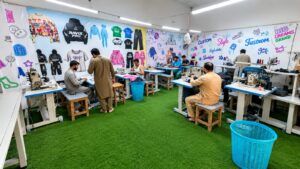
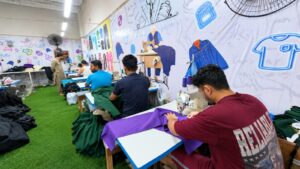
At Ravix Pro Industry we have manufactured sportswear since 2008 and now run more than 100 stitching and finishing machines with 150+ workers, producing 20,000+ pieces a month for over 500 brands and clubs in 50+ countries. Every order follows the same 11 steps: quote, design, approval, sample, cutting, decoration, stitching, thread trimming, quality check, packing and door-to-door shipping. Sublimation, screen printing, DTF and embroidery happen in-house, so we control colour, print quality and timing ourselves. See our manufacturing process and quality checks.
Ready to start? Request a free quote or message us on WhatsApp with your design, quantity and sizes. MOQ from 30 pieces per design. We reply within 24 hours.
FAQs
Is Bangladesh cheaper than Pakistan for clothing?
For very large runs of basic cotton garments, usually yes. For sportswear, fleece and runs under about 1,000 pieces, Pakistan is often equal or cheaper on landed cost.
What is the MOQ in Bangladesh vs Pakistan?
Large Bangladeshi factories often require 1,000+ pieces per style. Pakistani sportswear factories often start at 30–100 pieces per design; Ravix Pro starts at 30.
Which country is better for sportswear?
Pakistan, mainly because of the Sialkot sportswear cluster, which specialises in sublimated teamwear, combat sports gear and gloves.
Do both countries have duty-free access to the EU and UK?
Yes, on most garments today: Pakistan through GSP+ and Bangladesh through EBA in the EU, and both through the UK DCTS. Bangladesh’s EU terms will change after it leaves LDC status.
Which is faster, Pakistan or Bangladesh?
For small and mid runs, Pakistan is usually faster, with samples in 1–2 weeks and bulk in 2–6 weeks. Large Bangladeshi programmes are often planned 60–90 days ahead.
Sources
- Fibre2Fashion, “Bangladesh RMG exports down 1.6% to $38.7 bn in FY26”, July 2026: fibre2fashion.com
- Profit by Pakistan Today, “Pakistan’s textile exports remain stagnant at around $17 billion in FY26”, July 2026: profit.pakistantoday.com.pk
- The Daily Star, “UN committee recommends Bangladesh’s LDC exit deferment”, 2026: thedailystar.net
- Fibre2Fashion, “Bangladesh RMG net exports hit $24.22 bn: why import $9 bn in fabric?”, 2026: fibre2fashion.com
- GOV.UK, “Preference tiers under the Developing Countries Trading Scheme”: gov.uk
- European Commission, Access2Markets (EU tariff rates by product and origin): trade.ec.europa.eu